While my next blog post comes up, here's one to fill in the break.
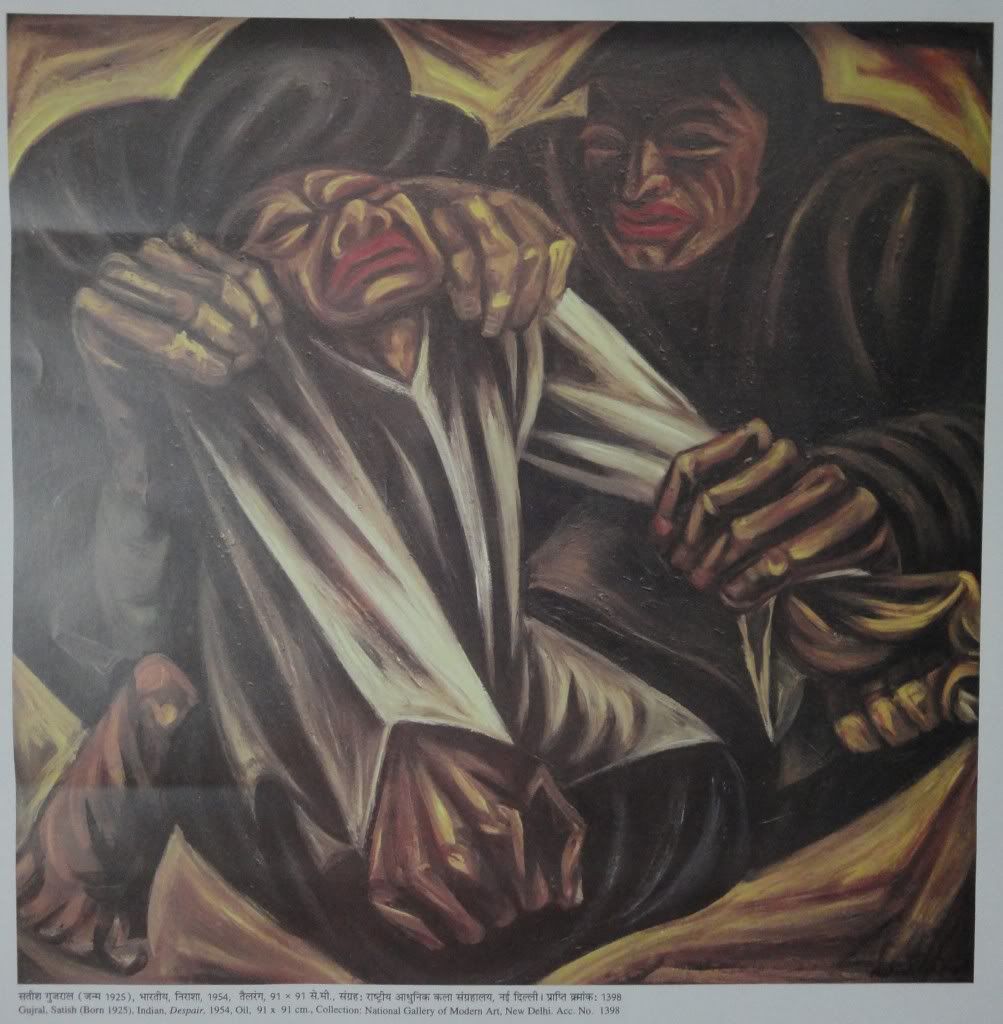
An analysis of a painting that I chose for my assignment, at the National Gallery of Modern Art, Bangalore; copyright reserved by NGMA New Delhi/Satish Gujral.
The Painting - Despair, Satish Gujral.
And my analysis of it:
RRJ
0914036
B.A. Honours in English Studies
World Literatures CIA 2 - Analysis and Interpretation of an Oil Painting
from the National Gallery of Modern Art: Despair
by Satish Gujral
[Note: This image is a reproduction from a poster of
the original painting; hence it would seem to lack a certain depth and
detailing, among other features. My deductions are based from this poster and
the original painting.]
This oil painting is by an Indian artist named
Satish Gujral, painted seven years after the Partition of India. It is titled Despair, and measures 91 cms by 91 cms.
It shows what appears to be two men and a third, faceless, entity who is
presumably not human.
The man in the white dress seems to be in utter
agony, rocking back and forth while in the throes of this despair. This
movement is implied by the three hands that seem to be trying to hold him back
from doing anything physically harmful to himself. The second man, whose face
can be seen, seems to be sympathising with this person. He is completely
dressed in black, and nothing of him can be seen save for his head and fists.
His hair blends in with his dark clothing; he is brown-skinned like the man in
white, and has both his hands placed on the latter in a restraining grip. Both
the men seem to be kneeling down on an unrecognisable surface.
The third recognisable 'entity' could possibly be
human, but I beg to differ. This "thing" seems to be gender-less, as
it does not have any recognisable features that could classify it into either
gender. It has one of its hands (its right fist) placed on the shoulders of the
man in white in a vice-like grip - I felt this was a representation of the Grim
Reaper. He[1]
is wearing a hood and is covered
entirely in black, except for a small part of his right arm. His right fist,
unlike the fists of the man in black, seem to be digging into the shoulders of
the man in white; his left fist does not seem to appear in the picture. I make
this deduction based on the comparative size of the fingers of the fist placed
on the man in white's left shoulder: the man's fingers look more typical of a
right handed fist rather than the left; however the placing of this 'right'
fist seems to make it look like it belongs to the entity's body.
The very first impression this painting caused me
was one of sudden - and deep - empathy. This man in white is definitely in the
clutches of a terrible sorrow that seems to be causing his unbearable pain. Hs
face is contorted into a wail of despair. This "despair", however,
strikes me as something that is probably more affective in nature, rather than
physical. I infer this due to the surreal atmosphere of this painting - this
painting has a very dream-like quality to it, and a blend of background colours
that contrast with the foreground and push it into the spotlight. The yellow
and brown hues contrast well with the dark black of the central characters; the
brush strokes of the background curve around the straighter strokes of the
central characters, framing it in a way. An additional factor that gave me this
impression is the depth that this painting seems to just radiate: it feels to
me like the fists of the man in white nearly come out of the painting. A few of
the above impressions will be detailed in the later sections of this essay.
This artistic text seems to imply a portrayal of the
magnitude of despair that gripped
'India' during, and post the Partition. The man in white and his dressing is,
to me, very reminiscent of the character of Nathu (played by Om Puri) in the
teleserial Tamas, directed by Govind
Nihalani, based on the novel of the same name by Bhisham Sahni. This character
is similarly dressed in this serial, and the painting aptly seems to portray
this character's emotions in a manner that is extremely hard-hitting and
in-your-face.
This painting uses straight lines in order to show –
or create – a sense of depth: it feels to me like the man’s supplication, with
his extended arms, almost come out of the painting. This adds a third dimension
to this painting; not only does it contain this, but also makes me feel like I
am somehow also looking at this person from above. This was indeed quite a
clever illusion to have been created on a two-dimensional painting surface. The
shapes that are used are quite sharp in nature; the skeletal appearance of the
man in white is a clear proof of this. This person’s fists are painted in great
detail, and are shown very clearly to be tightly gripped in a surge of
overwhelming emotion. The hands that restrain him, and the fingers that appear
to be causing him this pain are similarly painted.
There does not seem to be any clear division of the
canvas; however, the foreground (the fists and the man in white) and the middle
ground (the man in black and the Reaper) eclipse the background (what appears
to be the flooring, and an indefinable space at the top of the painting – both
painted in different shades of yellow and brown). This however, does appear to
contrast very well with the ‘darker’ colours of the foreground – among which
black seems to be the primary one. This colour also seems symbolic in a manner
of speaking: it can be seen as overpowering the forces of hope, peace and
purity that is signified by the white colour.
The brush strokes of the background seem to curve
around the central figures of this painting - the two men and the Reaper. The
colours used aren't very expressive, but the secondary colours are made to
blend in such a manner so as to create an impression of desolation and great
anguish on the discerning audience. There is a certain balance created in the
painting through the opposite corners, each of which helps the central
characters to take a position of absolute, unquestioning centrality in the
painting.
With regard to the perspective that I am provided
with, I am almost convinced that I am a partaker in the pain being suffered by
the man in white. I am provided with a view that makes me feel like I am in the
very scene itself; yet I am not able to reach out to this person and relieve
his anguish.
[1]
The Grim Reaper has never
been shown to have a clear gender classification, so this pronoun is used only
at an indicative level.